23.
10.
2026.
Department
Acting
Acting
Julia Jaroszewska on what it’s like to act and live in New York.
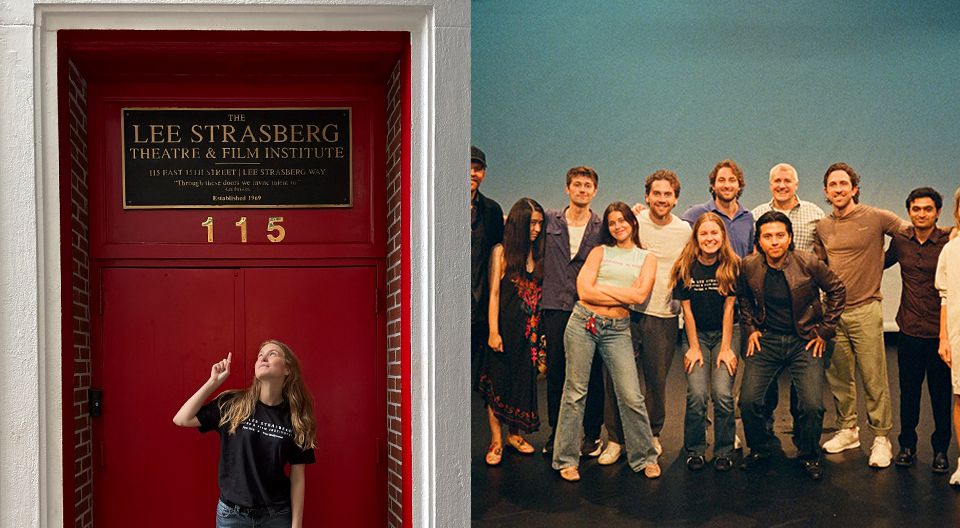
A student from our school’s Acting Department has returned from a semester of study at the prestigious Lee Strasberg Theatre & Film Institute in New York. Alumni of this institution include, among others, Robert De Niro, Al Pacino, Julia Roberts, and Scarlett Johansson. Julia’s stay in New York was made possible through a cooperation agreement between our school and the American institution. The Lee Strasberg Theatre & Film Institute was founded in 1969 by Lee Strasberg, an acting teacher who developed his own unique method. Today, the Strasberg Institute is one of the most highly regarded acting schools in the world.
Jolanta Karpińska: You spent a semester at the renowned Lee Strasberg Theatre & Film Institute in New York. How did that trip come about?
Julia Jaroszewska: It all began when I started working with an agency in New York. My agent truly believed in me and felt that I should get to know the American market to see if it was the right place for me. He knew Victoria Krane, the director of the Lee Strasberg Institute, and it was through her that the idea of a partnership with our school emerged. The rector of our school, Milenia Fiedler, decided to sign a cooperation agreement with the New York institution, and I was the first to go there. From now on, one final-year acting student from our school will study in New York each year. I am glad that I was able to blaze this trail!
J.K. Julia, you’re going to New York to study acting – how did you react to this idea?
J.J. My first reaction was shock and disbelief. At first, I thought there had been some kind of mistake. Ever since I was a child, America and Hollywood had been my great dream. I worked hard in Poland—attending music school and acting classes—and eventually, I got into the Lodz Film School; it took me four attempts, just like Janusz Gajos! Still, I knew what the realities were, and I found it hard to believe that my dream of America could actually come true.
J.K. What was studying at the Lee Strasberg Institute like? You spent two and a half months there—how did that period differ from your previous educational experiences?
J.J. I joined the school for what is known as the summer semester. It involved very intensive work and study. My curriculum was tailored to me personally and was highly diverse: I studied singing, acting for the camera, and movement. On average, I spent about 6 hours a day in classes. The school is international and incredibly diverse; my group included a professional Spanish actress and a model who wanted to enhance her expressiveness by studying acting.
J.K. The foundation of the training there is the renowned Lee Strasberg Method. Every student is required to take 8 hours of it per week. What did you discover within it?
J.J. For me, this was a total game-changer—the missing piece of the puzzle. Acting education in Poland is heavily rooted in the Russian tradition, where emotion and scene dynamics are very often built through tension. In the American approach, by contrast, tension arises solely from the text and the pacing established by the director. The foundation of the Strasberg method is relaxation—letting go of tension. Genuine emotions can only flow when a person is relaxed and has unrestricted access to those feelings. Previously, I would often feel my body tense up as I tried to achieve a specific effect. But when someone finally told me, "Just relax, and the emotions will flow on their own"—it simply worked. I have immense respect for the approach taken by American instructors. They create an incredible space for their students—a space that allows for mistakes and encourages individuals to find their own unique path. You aren't working solely to achieve a final result; you might spend a week—or even a month—working on a single scene, depending on how deeply you choose to engage with the process.
J.K. Was this freedom-oriented approach evident only at the school, or throughout New York City?
J.J. New York is a city of freedom! No one judges you; there are no rigid frameworks or requirements to conform to set patterns. In Poland, we have a tendency to wear masks—to try to meet the expectations of others, to fit in. In doing so, you can lose sight of who you really are. Over there, that immense pressure was lifted from me. I realized that what is truly valuable is what belongs solely to me—what sets me apart from everyone else. Your individual traits define your uniqueness; they open doors and create significant opportunities.
J.K. Which professor has particularly stuck in your memory?
J.J. Definitely Tim Crouse, our instructor for the Method. Before I left, I watched recordings of his lectures and immediately sensed that he was a man with vast experience and a true sense of mission. Even though he had worked with some of the biggest names in the industry—including Tom Hanks—there wasn’t a shred of an inflated ego about him. He possessed an extraordinary intuition and a great deal of empathy, while also providing constructive feedback. Another key figure was Ted Zurkowski, a director and actor with whom we worked on Shakespeare. In Poland, I never felt confident working with verse, but after our first session, Ted remarked that my voice revealed a solid foundation—which just goes to show how unobjective we can be about ourselves. I also have very fond memories of Victoria Krane, the director of the Institute; as I was leaving, she told me that the Institute was now my artistic home.
J.K. Studying in a foreign language and living in such a vast metropolis must have been quite a challenge for you.
J.J. Definitely! Although I had prepared myself linguistically for the trip, the first two weeks were an immense challenge. My brain was working at full capacity. Conversing in a foreign language is one thing, but studying in one is something else entirely. After returning from classes, I would simply collapse from exhaustion. Over time, I broke through that barrier, and functioning in a foreign language ceased to be an issue at all. As for the city itself—New York is like "Warsaw multiplied by ten"! There’s an intense, frantic pace on the streets of Manhattan; you can’t walk too slowly, as the crowd just carries you along. Fortunately, I lived in quieter areas, such as Queens, where I could unwind after classes. I also stayed in Brooklyn and in a predominantly Latino neighborhood—that’s where I had the best Mexican food of my entire life! I also made an effort to explore New York. I managed to take a boat cruise around the Statue of Liberty and spent time in Central Park—which, for a fan of the TV show "Friends" like me, was an absolute must!
J.K. Did the Americans you met know our school?
J.J. They primarily associate our school with Roman Polanski. Even the name "Łódź" proved difficult for them to pronounce. I explained that we are the oldest and best film school in Poland. They were amazed when I told them about our educational system—specifically that, as actors, we write a master’s thesis and earn a Master of Arts degree. They were also surprised to learn that, in Poland, about 150–180 new actors graduate from acting schools each year—a number we consider to be quite high given the limited market. To them, compared to the tens of thousands of students graduating from similar programmes in the U.S., that figure seemed almost negligible.
J.K. With what mindset have you returned to Łódź?
J.J. With a readiness to work, but also with a sense of mission. Perhaps one day I’d like to lead a workshop or a course on the Strasberg Method, to share the knowledge I gained there—knowledge I consider incredibly valuable for an actor. This experience gave me a great sense of perspective and made me realize how important it is to believe in one’s own dreams and to trust the process. It’s worth dreaming—with a kind of childlike naivety. And hard work and determination truly do bear fruit.
photos: private archive