26.
03.
2026.
Department
DOP
DOP
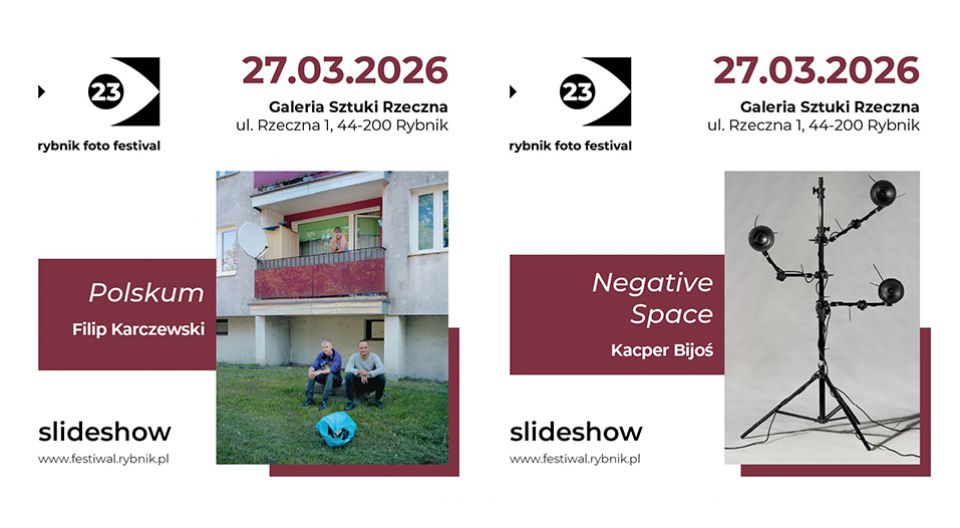
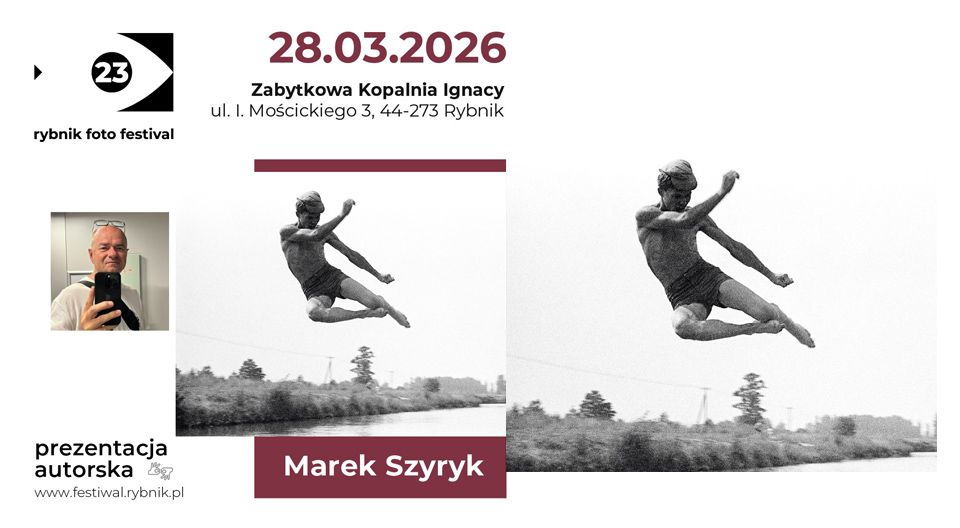
Filip Karczewski and Kacper Bijoś were recognized by the festival jury and will present their photographic series in the Slideshow section. We invite you to the Festival from 27-29, March.
Rybnik Foto Festival. "We show what is important, beautiful, informative and fresh. We have been integrating with good photography since 2004." This is how the organizers announced the 23rd festival edition.
Born in Toruń in 2001, Filip Karczewski is a documentary photographer and current student at the Lodz Film School. His work focuses on documentary and activist photography, where he experiments with the medium, expanding its boundaries with new media and socially engaged art. His work explores themes of historical memory, Eastern European identity, and social conflict.
POLSKUM is a photographic journey along Poland's borders undertaken in the summer of 2024—the result of a two-month hitchhiking expedition exploring what lies on the fringes of the map. The project documents Polish borderlands, their infrastructure, daily life, and their complex political contexts. Photographs from the southern borders and coastline explore the tourist and leisure dimensions of these areas, places where the border becomes an almost exotic destination in itself. Images from the Polish-German border refer to the past, the Recovered Territories, and the present day reality of economic migration. They venture into abandoned border crossings, now ruined or absorbed by the everyday life of the Schengen Area. Meanwhile, photographs from the North-East carry the weight of the present: from scenes of daily life on the Russian border, through the traces of the humanitarian crisis on the Polish-Belarusian border, to the tensions of migration and war in Ukraine. Together, these images create a story about borders, both those we have been forced into and those we ourselves have set. "Polskum" is a reflection on the identity of contemporary Poland, on landscapes where the past constantly resurfaces, on current tensions, and on the space where memory and prejudice intertwine in the everyday experience of life on the fringes.
The project was created in cooperation with Zuzanna Kluska.
Kacper Bijoś is a visual artist whose practice focuses on documenting the surrounding reality, reinterpreting local topography, and incorporating staging into the creative act. He uses photography as his primary tool, simultaneously experimenting with sound elements and video forms. He draws much inspiration from his native region, the Subcarpathian region, with its customs, history, local heritage, and untold stories. His work has been exhibited at the Contemporary Art Gallery in Opole, the State Art Gallery in Sopot, and the Fort Institute of Photography in Warsaw. He is currently a photography student at the Lodz Film School.
The starting point for the Negative Space photography series is the observation of the landscape and its elements, including the vanishing practice of constructing scarecrows. These everyday agrarian figures are systematically disappearing. I reinterpret traditional, makeshift silhouettes by constructing "new" objects. They carry contemporary meanings and symbolism, referencing our reality. In the first part of the project, I construct original objects which evoke traditional forms and shapes. I embed them in Alicja Tkaczyk's designs, created in the spirit of trashion—the reprocessing of materials—corresponding to the concept of redefinition and transformation.
In my latest project, I consider how the role of the scarecrow will evolve in the near future. With the ongoing modernization of plant protection products and the implementation of modern technologies, the original object is gaining new properties, such as audio, visual, and digital capabilities, and is being integrated with electronics. Its form is slowly transforming towards unity and simplification, in terms of the originality of the materials used and the shape of the structure.
Festival programme: festiwal.rybnik.pl/program
See you in Rybnik!
#23RFF #RybnikFotoFestival #festiwalfotografii #GaleriaRzeczna #slideshow
Born in Toruń in 2001, Filip Karczewski is a documentary photographer and current student at the Lodz Film School. His work focuses on documentary and activist photography, where he experiments with the medium, expanding its boundaries with new media and socially engaged art. His work explores themes of historical memory, Eastern European identity, and social conflict.
POLSKUM is a photographic journey along Poland's borders undertaken in the summer of 2024—the result of a two-month hitchhiking expedition exploring what lies on the fringes of the map. The project documents Polish borderlands, their infrastructure, daily life, and their complex political contexts. Photographs from the southern borders and coastline explore the tourist and leisure dimensions of these areas, places where the border becomes an almost exotic destination in itself. Images from the Polish-German border refer to the past, the Recovered Territories, and the present day reality of economic migration. They venture into abandoned border crossings, now ruined or absorbed by the everyday life of the Schengen Area. Meanwhile, photographs from the North-East carry the weight of the present: from scenes of daily life on the Russian border, through the traces of the humanitarian crisis on the Polish-Belarusian border, to the tensions of migration and war in Ukraine. Together, these images create a story about borders, both those we have been forced into and those we ourselves have set. "Polskum" is a reflection on the identity of contemporary Poland, on landscapes where the past constantly resurfaces, on current tensions, and on the space where memory and prejudice intertwine in the everyday experience of life on the fringes.
The project was created in cooperation with Zuzanna Kluska.
Kacper Bijoś is a visual artist whose practice focuses on documenting the surrounding reality, reinterpreting local topography, and incorporating staging into the creative act. He uses photography as his primary tool, simultaneously experimenting with sound elements and video forms. He draws much inspiration from his native region, the Subcarpathian region, with its customs, history, local heritage, and untold stories. His work has been exhibited at the Contemporary Art Gallery in Opole, the State Art Gallery in Sopot, and the Fort Institute of Photography in Warsaw. He is currently a photography student at the Lodz Film School.
The starting point for the Negative Space photography series is the observation of the landscape and its elements, including the vanishing practice of constructing scarecrows. These everyday agrarian figures are systematically disappearing. I reinterpret traditional, makeshift silhouettes by constructing "new" objects. They carry contemporary meanings and symbolism, referencing our reality. In the first part of the project, I construct original objects which evoke traditional forms and shapes. I embed them in Alicja Tkaczyk's designs, created in the spirit of trashion—the reprocessing of materials—corresponding to the concept of redefinition and transformation.
In my latest project, I consider how the role of the scarecrow will evolve in the near future. With the ongoing modernization of plant protection products and the implementation of modern technologies, the original object is gaining new properties, such as audio, visual, and digital capabilities, and is being integrated with electronics. Its form is slowly transforming towards unity and simplification, in terms of the originality of the materials used and the shape of the structure.
Festival programme: festiwal.rybnik.pl/program
See you in Rybnik!
#23RFF #RybnikFotoFestival #festiwalfotografii #GaleriaRzeczna #slideshow